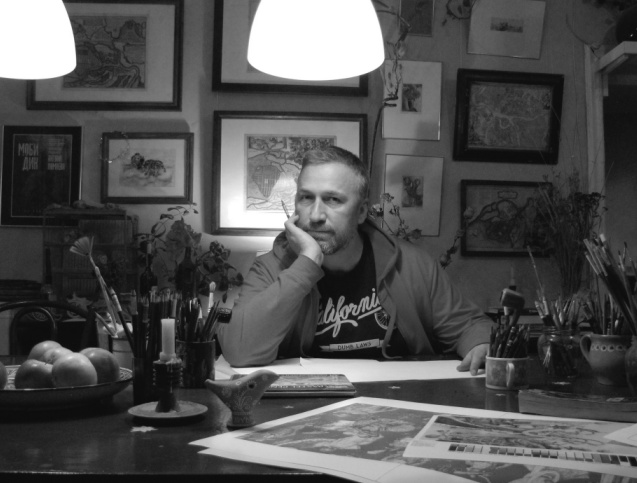
Anton Lomaev is one of the most significant figures of contemporary Russian illustration, internationally renowned for his works. Each of his books becomes not merely a visualization of a narrative, but a carefully constructed work of art, inviting the reader to wander slowly through its pages. Lomaev’s illustrations reestablish the ancient bond between literature and painting, reminding us of the timeless power of fairy tales, myth, and imagination. We spoke with Anton Lomaev within a broad framework, ranging from the tradition of Russian iconography to contemporary book illustration, from Eastern imagery to aesthetic thought, and the impact of artificial intelligence on art.
To begin with, let’s briefly get to know you. How did you start drawing, and how does your relationship with a text take shape when you begin illustrating it? How does your process of reading, research, and visual preparation usually unfold?
I have been drawing since my earliest childhood. From that time on, my drawings were closely connected with various texts and books. I learned to read early, and many of my first works were reactions to what I had read. They were not illustrations, of course, but rather fantasies inspired by literature. Until entering the Academy of Arts, however, I did not intend to connect my life with books. I wanted to be a painter.
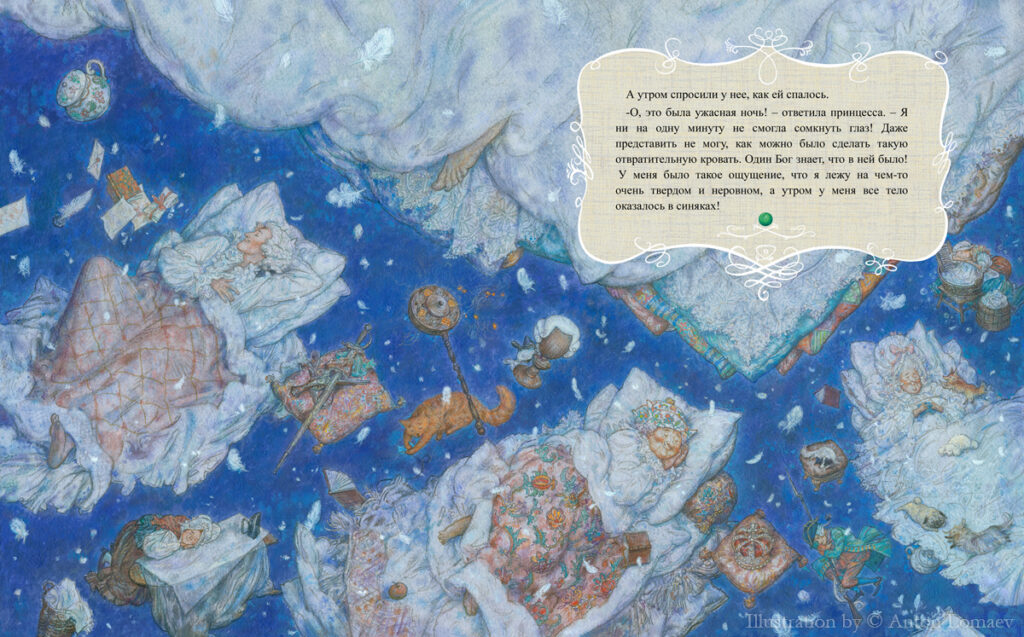
When I read a text that I am going to work with, I indulge in fantasy and wait for interesting images of future illustrations to mature in my mind. I approach the illustrations themselves without haste. First, I think through the format and dimensions of the book, design its layout, make sketches of characters and landscapes, and study historical materials if the project requires it.
What difficulties or main challenges do you most often face in the process of working on illustrations? Are there themes or aspects you still continue to struggle with?
There are always many difficulties. This is a natural part of the work. But difficulties and overcoming them are an important part of the creative craft. For a long time now, I have chosen the subjects for illustration myself, so I do not work with books or themes that might be uninteresting or unpleasant to me. At the very beginning of my career, I worked on commissions from publishing houses, but that was difficult for me. I chose the risky path of a freelance book artist and did not regret it. Today I have my own publishing house, where I publish only what I like.
Russia has a very strong and deep tradition of iconography, which over time evolved into such unique forms as Palekh. Do you feel the influence of this iconographic tradition in your own visual language? Do you think this aesthetic heritage can remain alive and relevant for contemporary illustration?
When you are young and studying, you often imitate or take an existing style as a foundation. A mature artist tends to search for their own artistic language. Therefore, I do not feel myself to be within the tradition of iconography or “Palekh.” However, the Russian icon has always fascinated me as an aesthetic phenomenon in which the abstract origin of the image is very closely connected with meaning and spirituality. In this sense—yes, the icon attracts me as an example of high art.
Contemporary art, including the art of illustration, is extremely diverse. Despite the fact that there are always fashionable trends, every style can find its place, because readers’ tastes are also very diverse.
In your opinion, can we speak of the existence of a general “Russian illustrative style”? If so, what key visual or conceptual features would you identify as defining this style?
I think we can. But I would say that the Russian style in illustration has two powerful sources. The first is the World of Art movement of the early twentieth century, when a circle of brilliant artists formed around the magazine of that name. Representatives of this circle include Bilibin, Somov, Lansere, Benois, Bakst… The second strong school of Russian illustration emerged in the wake of the Revolution, when art was searching for a new language. Among the prominent book artists of this direction, I would name Lebedev, Pakhomov, Vasnetsov, Tyrsa, Konashevich… These approaches to illustration are very different from one another, yet both are characteristic of Russian illustration even today.

In your work, a significant place is occupied by stories set in the East (“The Emperor’s New Clothes,” “Little Muck,” and others). From a Western perspective, this visual world is sometimes described as “orientalist.” How do you approach the question of cultural representation in such stories? Is the East for you more of an aesthetic space or a narrative world?
Yes, that is correct. I love drawing the East. But my attitude toward depicting it is similar to that of Wilhelm Hauff, whom I have illustrated many times. He never visited the East and never even left Germany. Yet this did not prevent him from inventing his own fairy-tale East. I have been to Turkey many times and I love this country. But when I draw the East, I allow myself to fantasize without thinking about accuracy. That is perfectly normal for a fairy tale.
In contemporary children’s literature, a minimalist and restrained visual language is becoming increasingly noticeable. How do you feel about this aesthetic trend?
As a viewer, I am very eclectic; my tastes are diverse. For me, the quality of an illustration is not determined by whether it is minimalist or detailed. I like what is talented. Today illustration is becoming more concise and minimalist. I see this as a reaction to the overload of images available to us, which come from everywhere, above all from the screens of our devices. I myself tend to work in a manner rich in detail. Perhaps this is a sign that I belong to a generation whose everyday life was poor in visual stimuli.

We live in an era in which artificial intelligence is rapidly changing the ways visual production works. How do you see the future of illustration in children’s books?
I think we have entered a time when artificial intelligence will increasingly intervene in our lives, including in the work of illustration. But I am not afraid of this. AI is a compiler; it uses human imagination. For artists, however, this is a challenge. The answer is to be genuinely creative, to move away from routine and clichés, and to strive to base one’s work on authentic creativity. The artist—the true artist, as I see it—will in the future become an even more important figure in society than today or yesterday, as original ideas will acquire ever greater value.