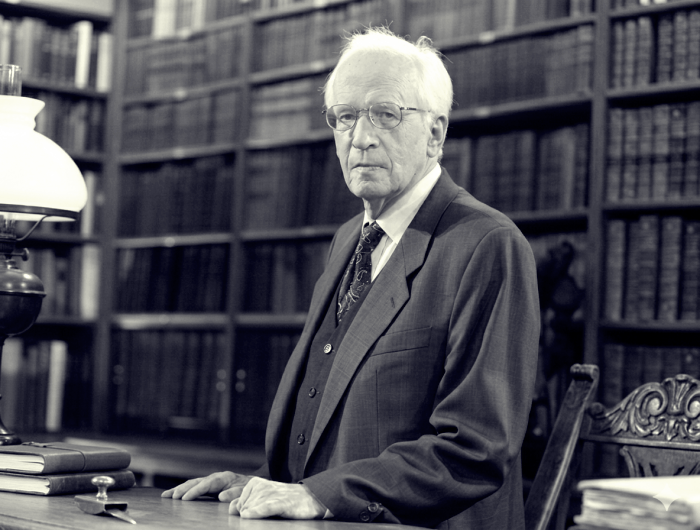
I conducted an interview regarding Ernst Nolte, one of the most controversial yet equally influential historians of the 20th century. As a student of Martin Heidegger, Nolte transitioned from philosophy to history, gaining significant attention for his ‘European Civil War’ thesis and his pivotal role during the Historikerstreit (Historians’ Quarrel). His intellectual relationship with Ernst Jünger was also a vital part of his world of thought.
I discussed these themes with Elisa D’Annibale, who has been a tenured researcher at the Italian Institute of Germanic Studies since 2021. She is the author of the book Ernst Nolte tra politica e storia. Un inedito per il centenario jüngeriano.
Ernst Nolte is considered one of the most controversial yet, at the same time, most influential historians of the 20th century. In your opinion, what are the fundamental elements that make him so relevant and different from his contemporaries?
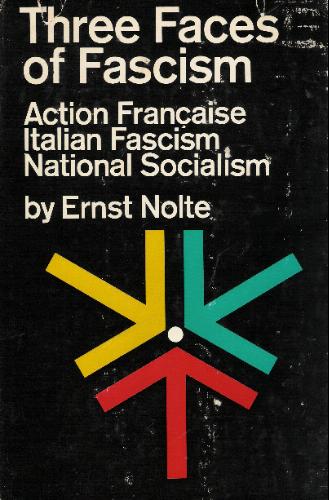
Ernst Nolte is a figure who escapes the traditional classifications of twentieth-century historiography because his work constantly places itself in a border zone between history and philosophy. This is the first element that explains both his relevance and his distance from many of his contemporaries: Nolte does not conceive of historiography as a mere empirical reconstruction of events, but as an attempt to interpret historical processes through long-term theoretical categories, subjecting these very categories to the test of historical experience.
In this sense, his method is profoundly original. It is neither purely historicist nor purely speculative, but is configured as a form of “philosophical history of the contemporary,” in which intellectual biographies, political movements, and ideological structures become true interpretive laboratories. It is precisely this approach that makes him different, for example, from a more empirical-documentary historiography or from strictly political-institutional approaches.
The second decisive element is represented by his interpretive categories, in particular that of the “European Civil War”—later expanded into the notion of a “Global Civil War.” With this key, Nolte proposes a vision of the twentieth century as a unified space of ideological conflict between Bolshevism and Fascism, breaking both national readings and rigidly chronological ones. It is a highly ambitious paradigm, which has the merit of restoring a comparative and transnational dimension to the study of totalitarianisms, but which at the same time introduces elements of rigidity and simplification, precisely because it tends to trace complex phenomena back to a single interpretive matrix.
A third aspect, equally relevant, concerns his position in the historiographical debate. Nolte is a historian who had a profound impact as early as the 1960s—one need only think of The Three Faces of Fascism—but who has been progressively identified almost exclusively with the Historikerstreit controversy of 1986. This reduction has contributed to obscuring the overall scope of his work, which instead spans several decades and addresses central nodes of European modernity: the relationship between Fascism and Bolshevism, the problem of totalitarianism, the link between ideology and violence, and the role of philosophy in historical understanding.
Finally, what makes Nolte particularly influential is his ability to ask radical questions, even at the cost of exposing himself to very harsh criticism. His historiography is never neutral or descriptive: it is a problematic historiography that forces the reader to confront the fractures of the twentieth century. It is precisely this tension—between interpretive ambition and the risk of overreach—that explains why Nolte has remained one of the most discussed, but also one of the most stimulating authors of the last century.
As a student of Martin Heidegger, Nolte arrived at history starting from philosophy. What intellectual motivation lies behind this transition? In what way, and at what conceptual level, did Heidegger’s philosophy influence Nolte’s historical methodology?
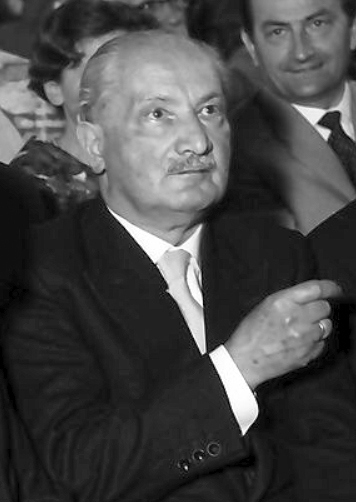
Nolte’s transition from philosophy to history should not be read as a simple disciplinary choice, but as the coherent outcome of a theoretical problem. Trained in the Heideggerian horizon, Nolte inherited a conception of philosophy that can no longer limit itself to abstract speculation: in Heidegger, in fact, historicity is the original dimension of existence. To understand the present therefore means confronting the historical processes in which it was constituted. This is precisely Nolte’s starting point: history becomes the place where philosophy can verify itself.
The intellectual motivation for his transition to history is therefore radical: Nolte turns to the phenomena of the twentieth century—Fascism, Bolshevism, totalitarianism—not as autonomous objects, but as manifestations of the crisis of European modernity. In this sense, his operation differs sharply from that of much post-war historiography, which tended to fragment the field into increasingly specialized areas. Nolte performs the opposite movement: he attempts to restore theoretical unity to the century.
The influence of Heidegger is grasped not so much in the content as in the structure of the method. Firstly, in the centrality of interpretive categories: Nolte constructs concepts—”Fascism,” “European Civil War,” “Global Civil War”—that organize historical material within a framework of meaning. Secondly, in the search for essential links: the relationship between Bolshevism and Fascism is not for him a simple chronological succession, but a structural relationship that defines the field of tension of the twentieth century. Finally, in the conception of history as a problematic totality, traversed by an internal logic that the historian must bring to light.
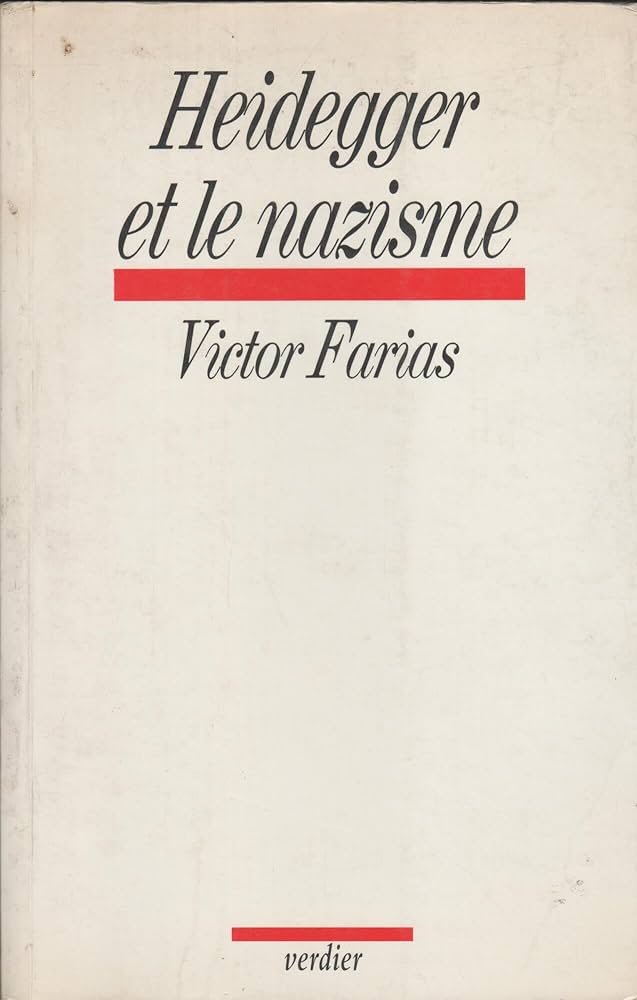
It is precisely on this ground that Nolte’s confrontation with the so-called “Heidegger case” is situated. The publication of Víctor Farías’s volume, Heidegger and Nazism (1987), had in fact clamorously reopened the debate on the relationship between philosophy and politics in Heideggerian thought, pushing many interpreters to read the entire work in light of his involvement with National Socialism. Nolte intervened indirectly in this discussion with his 1992 volume, Martin Heidegger: Politics and History in His Life and Thought, in which he proposed a more complex and less reductive reading. What emerges from this work is extremely significant for understanding his historical methodology as well. Nolte does not deny the problem of the relationship between Heidegger and National Socialism, but he refuses to reduce philosophy to a simple expression of a contingent political choice. On the contrary, he insists on the need to grasp the intertwining—often problematic and unresolved—between philosophical thought and historical contingency. It is exactly the same approach that he applies to the twentieth century: never completely separating ideas from their context, but never dissolving them into it either.
In this sense, the comparison with Farías is revealing. Where Farías tends to establish a direct and almost deterministic link between philosophy and National Socialism, Nolte introduces a more articulated perspective, attentive to mediations, ambivalences, and transformations over time. This difference does not concern only Heidegger but reflects two opposite ways of understanding the relationship between thought and history: one reductive and linear, the other problematic and structural.
The comparison with other historians further clarifies Nolte’s specificity. If one thinks of De Felice, for example, a decisive divergence is caught: while sharing an interest in unconventional interpretations of Fascism, De Felice remains anchored to a method based on documentary verification and the distinction of contexts. Nolte, instead, lets the theoretical category precede and orient the empirical analysis. Similarly, compared to post-war German historiography—often cautious and distrustful of grand theoretical syntheses—Nolte appears as an anomalous figure who asserts the need to interpret the twentieth century as a unitary process.
Ultimately, Heidegger’s legacy in Nolte does not consist in a direct transfer of content, but in a theoretical attitude: the conviction that history must be thought, and not just reconstructed. The confrontation with the debate opened by Farías and the reflection developed in the 1992 volume clearly show how Nolte constantly seeks to hold philosophy and history together, avoiding both separation and the reduction of one to the other. It is precisely this tension—between theoretical ambition and the risk of overreach—that makes his historiography at once so original and so controversial.
What was Nolte’s approach toward the “Conservative Revolution” (Konservative Revolution) movement? Why did he have such an interest in this phenomenon and its key figures?
Nolte’s interest in the so-called “Conservative Revolution” is neither antiquarian nor merely reconstructive: it is, once again, theoretical. Nolte does not look at this heterogeneous collection of authors and currents—from Jünger to Moeller van den Bruck, up to Schmitt—as a simple episode of German intellectual history, but as a laboratory in which some of the decisive categories of the European twentieth century were formed.
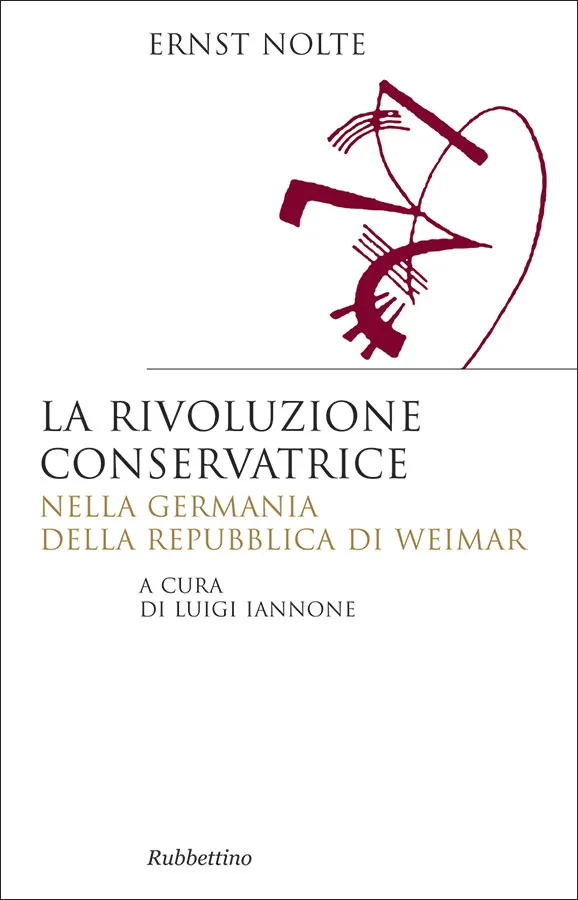
What attracts him is the liminal character of this phenomenon. The “Conservative Revolution” represents, in his reading, an intermediate space between tradition and modernity, between the rejection of the liberal order and the search for new political forms. It is not yet National Socialism, but it is no longer classical conservatism either: it is a zone of transition in which responses to the crisis of modernity are radicalized. It is precisely this ambiguity that makes it, for Nolte, historically decisive.
The motivation for his interest is therefore closely linked to the central problem of his reflection: understanding the origin and nature of Fascism. In this sense, the “Conservative Revolution” appears to him as a genetic moment, or rather as a context of ideological elaboration without which Fascism cannot be fully understood. It is not a matter of establishing a direct and mechanical line of continuity, but of identifying a field of possibilities, a cultural horizon within which certain forms of political thought develop.
Once again, the method is decisive. Nolte reads these authors not simply as individuals, but as historical symptoms. Their works become privileged documents for grasping the transformation of the political and anthropological categories of the twentieth century. In this sense, the choice to dwell on figures like Jünger or Schmitt is not accidental: both represent, albeit in different ways, extreme attempts to think through the crisis of modernity and to respond to the challenge represented by Bolshevism.
It is here that the deepest link with his general interpretation of the century emerges. Nolte identifies in the “Conservative Revolution” one of the first articulations of what would become the central dynamic of the twentieth century: the radical confrontation between totalizing ideologies. His interest in these authors derives from the fact that they anticipate, on a theoretical level, that “European Civil War” which he would identify as the interpretive key to the 1917–1945 period.
However, precisely on this point, the ambiguity of his position also comes into play. Nolte tends to read the “Conservative Revolution” in function of its historical outcome, that is, in light of Fascism and National Socialism. This approach allows for the grasping of deep connections, but it also carries the risk of back-projecting meanings and reducing the complexity of a phenomenon that was anything but unitary. In other terms, the strength of his interpretation—the ability to place these figures within an overall framework—is also its limit.
The comparison with other historiographical approaches further clarifies this point. A significant part of German historiography, especially from the 1970s onwards, has insisted on the internal plurality of the “Conservative Revolution,” highlighting its differences, tensions, and discontinuities. Nolte, instead, privileges what unites these experiences: the common response to the crisis of liberal modernity and the search for a radical alternative. It is an interpretive choice that sacrifices micro-analysis in favor of the construction of a broader theoretical framework.
If one then looks at the comparison with De Felice, a further difference emerges: while Nolte tends to read intellectual currents as moments of a general ideological dynamic, De Felice maintains a greater attention to the specificity of national contexts and the politico-social dimension of phenomena. Again, Nolte appears more as a philosopher of history than a historian in the strict sense.
Ultimately, Nolte’s interest in the “Conservative Revolution” is explained by his need to identify the places where modernity enters into crisis and generates radical responses. It is not a neutral interest: it is part of a larger project, that of reading the twentieth century as a global field of ideological tension. And it is precisely this approach that makes his interpretation at once extremely stimulating and inevitably controversial.
Why, during the “Historians’ Quarrel” (Historikerstreit), did Nolte become the target of such fierce criticism? Did the objections raised by his critics, primarily Jürgen Habermas, concern his historiographical method or the political implications of his way of interpreting the German past?
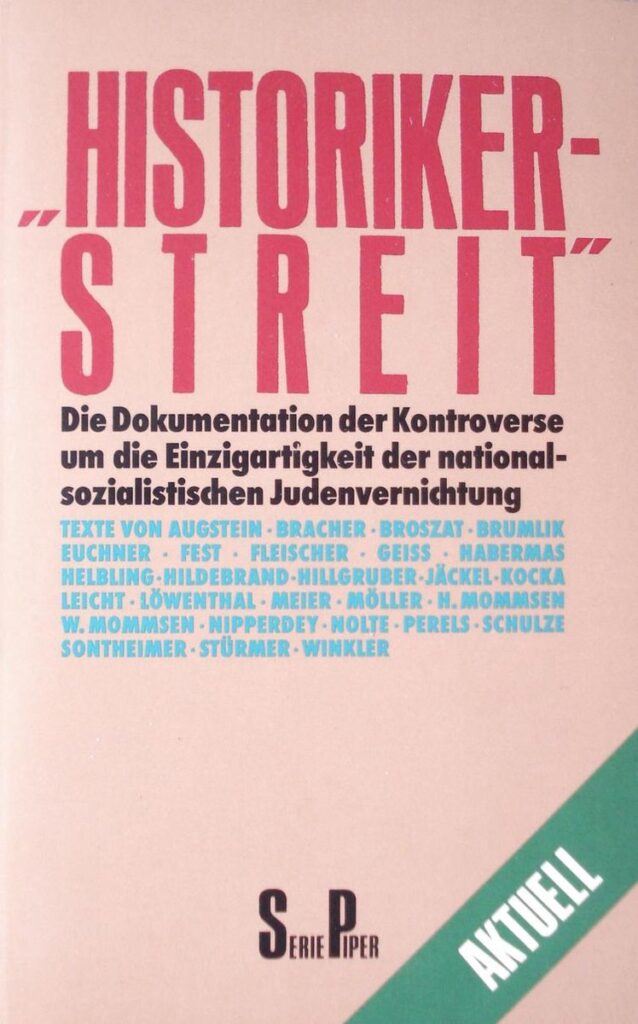
Nolte became the target of such fierce criticism during the Historikerstreit because his intervention was not limited to proposing a new interpretation of National Socialism, but touched the most sensitive point of West German historical culture: the relationship between historical explanation and moral judgment. In other words, what was being called into question was not only a historiographical problem, but the very way in which post-war Germany had constructed its identity through the confrontation with the Nazi past.
Nolte’s thesis—in its most discussed formulation—introduced a link between Bolshevism and National Socialism, suggesting that the latter could be read, at least in part, as a response to the former. Placed within the broader framework of the “European Civil War,” this interpretation implied a comparability between phenomena that a significant part of historiography and public culture tended to keep separate, especially regarding the Shoah. It was not simply a matter of establishing analogies, but of redefining the position of National Socialism within the history of the twentieth century.
It is here that the radical nature of the reaction is understood. Formally, the objections raised by the critics—and in the first place by Jürgen Habermas—present themselves as methodological criticisms: Nolte is accused of constructing causal links that are not sufficiently grounded, of operating with categories that are too broad, and of forcing historical comparison to the point of producing a reductive reading. However, to stop at this level would be misleading. The heart of the conflict is not methodological, but politico-cultural.
Habermas grasps with great clarity that the issue does not only concern the way of doing history, but the way in which history affects the public sphere. His critique moves on a different plane from that of Nolte: it is not limited to contesting the validity of a thesis but calls into question its effects. The central point is the fear that such an approach could produce a “normalization” of the Nazi past, that is, reinserting it into a comparable and therefore, at least in part, relativizable historical dynamic. In this sense, the polemic against Nolte is also a defense of a principle: the irreducibility of the Shoah to ordinary historical categories.
This divergence reflects two profoundly different conceptions of historiography. On the one hand, Nolte claims a history as a field of theoretical inquiry, which cannot renounce comparison and the construction of long-term links, even when these prove uncomfortable or destabilizing. On the other hand, Habermas defends a conception of history which, in the German case, inevitably also has a normative function: the memory of National Socialism is not only an object of knowledge, but an ethical foundation of post-war democracy.
It is in this intertwining that the violence of the debate is explained. The Historikerstreit is not a clash between equivalent interpretations, but between two ways of understanding the relationship between history and politics. Nolte, consistently with his philosophical training, tends to consider history as a space of radical interrogation, in which even the most consolidated categories can be called into question. Habermas, instead, insists on the fact that, in a context like the German one, the freedom of historical inquiry cannot be separated from the political responsibility of its implications.
To this is added a further element, often underestimated: the historiographical context of post-war Germany. After 1945, a cautious interpretive line had progressively established itself, marked by a distrust of grand theoretical syntheses and a strong focus on the specificity of National Socialism. Nolte broke this balance: he reintroduced a global perspective, reopened the question of the comparison between totalitarianisms and, above all, attempted to reinsert National Socialism into a broader history of European modernity. It was this gesture, even before the individual theses, that proved destabilizing.
In this sense, the figure of Nolte appears deeply ambivalent. On the one hand, he restores a strong, theoretical function to historiography, capable of questioning the overall sense of the twentieth century; on the other, he underestimates the specificity of the context in which he intervenes, namely the fact that, in Germany, the Nazi past is never just a historical problem, but an identity and political node. It is precisely this unresolved tension that transformed an academic controversy into a public clash of extraordinary intensity.
Ultimately, the criticisms directed at Nolte cannot be traced back exclusively to either method or politics: they arise at the point where the two levels overlap. And this is perhaps the most significant fact of the Historikerstreit: having shown with extreme clarity that, in the case of the German twentieth century, every historical interpretation is inevitably also a stance on the present.
Coming to the central theme of your book: how did the dialogue between Ernst Jünger and Ernst Nolte begin? In what way did these two figures influence each other?
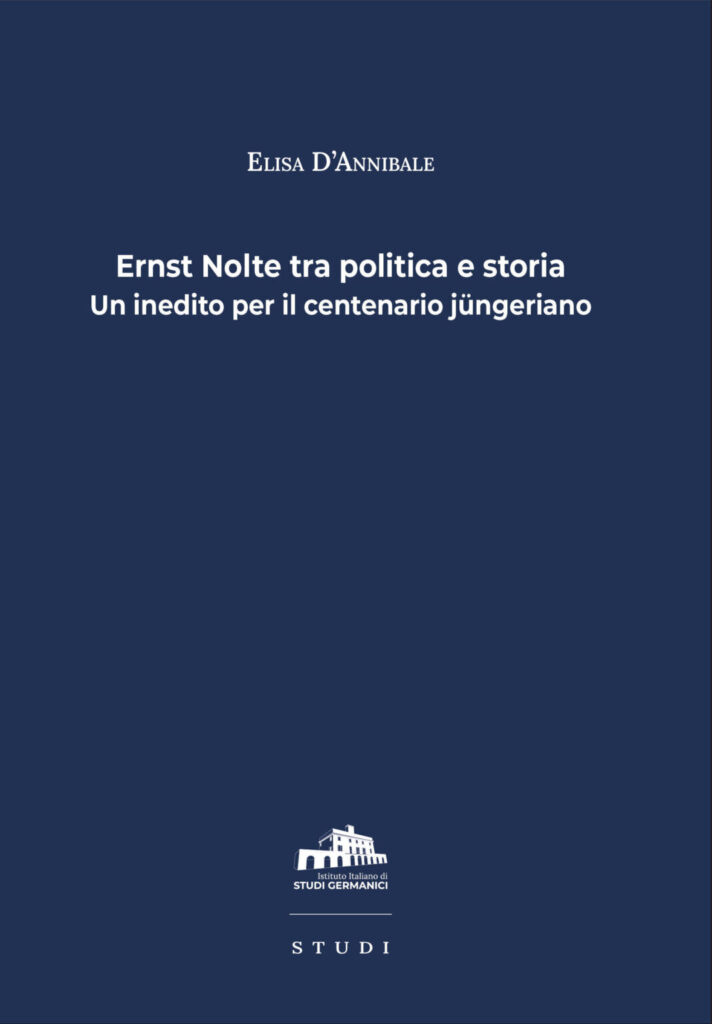
The dialogue between Ernst Jünger and Ernst Nolte does not begin as a direct and continuous relationship in the traditional sense of the term, but as an intellectual confrontation that develops over time and finds a particularly significant point of condensation in the 1995 unpublished piece included in the appendix to the volume. It is precisely the analysis of this text that shows how, more than a simple homage, it represents a stage of Nolte’s reflection, in which the figure of Jünger becomes a true theoretical tool.
An interesting element concerns the editorial genesis of this essay. Nolte’s text on Jünger had in fact been conceived to be published in Indro Montanelli’s La Voce for the writer’s hundredth birthday. This fact is not secondary: it places Nolte’s intervention in a precise public space, that of Italian cultural journalism, and shows how he intended to address not only an academic audience but a broader European horizon. The fact that the text was not published and remained unpublished for a long time further accentuates its value. It gives us a Nolte who, even in the nineties, continues to measure himself against the key figures of the twentieth century and chooses Jünger as a privileged interlocutor to rethink, once again, the meaning of the century. In this sense, the essay is located not at the margins, but at the center of his intellectual parable.
For Nolte, in fact, Jünger is not just a writer or a witness of the century, but a paradigmatic figure through which to read the crisis of modernity. This is the decisive point: their “dialogue” takes place at a conceptual rather than biographical level. Nolte interprets Jünger as one of the most radical expressions of that anthropological and political transformation that crossed the twentieth century and inserts him within the framework of the “European Civil War,” later expanded into the dimension of the “Global Civil War.”
In this sense, it can be said that Jünger’s influence on Nolte is above all indirect but profound. Jünger offers Nolte privileged material: his works represent a sort of experiential laboratory in which the tensions of the twentieth century—from the centrality of the war experience to the reflection on technology, up to the ambivalences of the relationship with National Socialism—manifest themselves in almost exemplary form.
On the other hand, the influence also proceeds in the opposite direction, although in a more limited way. Nolte contributes to redefining Jünger’s place within the history of the twentieth century, removing him from purely literary readings and inserting him into a broader historical-philosophical perspective. Jünger thus becomes, through Nolte, not only a controversial author but a theoretically decisive figure.
The most interesting point, however, is the way in which Nolte uses Jünger. He does not limit himself to interpreting him: he “puts him to the test.” Jünger’s intellectual biography becomes for Nolte a testing ground for his own interpretive categories. The concept of “Global Civil War,” for example, is not simply applied to Jünger, but is clarified and strengthened precisely through this analysis.
At the same time, this relationship also highlights the limits of Nolte’s approach. The tendency to trace Jünger back to a unitary interpretive scheme sometimes risks attenuating his complexity and discontinuities, flattening the ambivalences and transformations of his path. Jünger is a figure crossed by profound discontinuities, while Nolte tends to trace them back to a broader coherence. Once again, the systematic strength of the method coincides with its critical point.
Ultimately, the dialogue between Jünger and Nolte is not so much that between two authors linked by a direct influence, as that between two different ways of questioning the twentieth century. Jünger crosses it as lived and written experience; Nolte reconstructs it as a theoretical problem. The fact that this confrontation also takes shape in a text intended for Montanelli’s La Voce—that is, for an Italian public space—shows with particular evidence how this dialogue belongs to a fully European dimension, in which history, philosophy, and political culture continue to intertwine.
Both in the recent past and today, there is a vast literature in Italy on the Conservative Revolution and its main exponents. On what historical and intellectual basis does this deep Italian interest in these themes rest, in your opinion?
This is a complex issue, to which I will try to respond by proposing my own interpretation.
The breadth of Italian literature on the “Conservative Revolution” can be explained, in my opinion, by considering two specificities together: that of Italian political history and that of its intellectual tradition.
On the historical level, Italy is one of the few European countries that has known an indigenous and early fascist experience. This produced, already in the post-war period, the need to question not only Fascism as a political phenomenon, but its cultural and European roots. In this context, the German “Conservative Revolution” appeared as a privileged terrain: not because it coincides with Fascism, but because it allows it to be placed within a broader crisis of liberal modernity. The Italian interest therefore arises from an interpretive necessity: to move beyond a purely national reading of Fascism and understand it within a European horizon.
But this is not enough. There is a deeper reason, which concerns the very structure of twentieth-century Italian culture. Unlike other contexts, in Italy a strong permeability between history, philosophy, and political theory was maintained for longer. It is within this tradition that the early attention of figures like Delio Cantimori is placed, who confronted these currents directly as they were taking shape or being reworked. Think of all the Cantimorian journalism of the twenties and thirties. The “Conservative Revolution” was read not only as a historical object but as a theoretical place in which decisive questions are concentrated: the relationship between crisis and decision, between technology and politics, between nihilism and order.
This also explains a fundamental difference compared to Germany. In the German context, these themes were for a long time burdened by the weight of National Socialism and therefore subjected to strong political and memorial tension. In Italy, however, even within a far from neutral confrontation with Fascism, they could be addressed with greater theoretical freedom. This favored a broader, but also more ambiguous, reception: more open to conceptual reflection, sometimes less bound to rigorous historical contextualization.
It is in this space that the fortune of authors like Jünger or Schmitt is also inserted. They are read not only for what they represent historically, but because they offer categories for thinking about the twentieth century as a whole. In other words, their reception in Italy is less “archival” and more theoretical.
And here lies the decisive point. The Italian interest in the “Conservative Revolution” does not arise from an ideological fascination, as has sometimes been said in a superficial way, but from a precise cognitive need: to understand the crisis of European modernity without reducing it either to a sequence of national events or to a simple interpretive scheme. It is a tradition of studies that, for better or worse, has never given up on holding history and theory together.
For this reason, rather than a publishing phenomenon, it is a cultural indicator. It signals that, in Italy, the question of the twentieth century has never been completely closed. And if this literature continues to grow, it is because that question—how to think together about politics, history, and the crisis of modernity—still remains, to a large extent, without a definitive answer.