
Daniele Velicogna is a graduate of Ca’ Foscari University of Venice. His research interests include history, political philosophy, and geopolitics. He currently works as a teacher within the Italian school system.
Ernst Nolte was not only a historian who studied political ideologies, but also a thinker who developed an original philosophy of history centered on modernity. In particular, the concept of “transcendence” (Transzendenz) used by him seems to hold significant importance in this context. What exactly did Nolte mean by this concept?
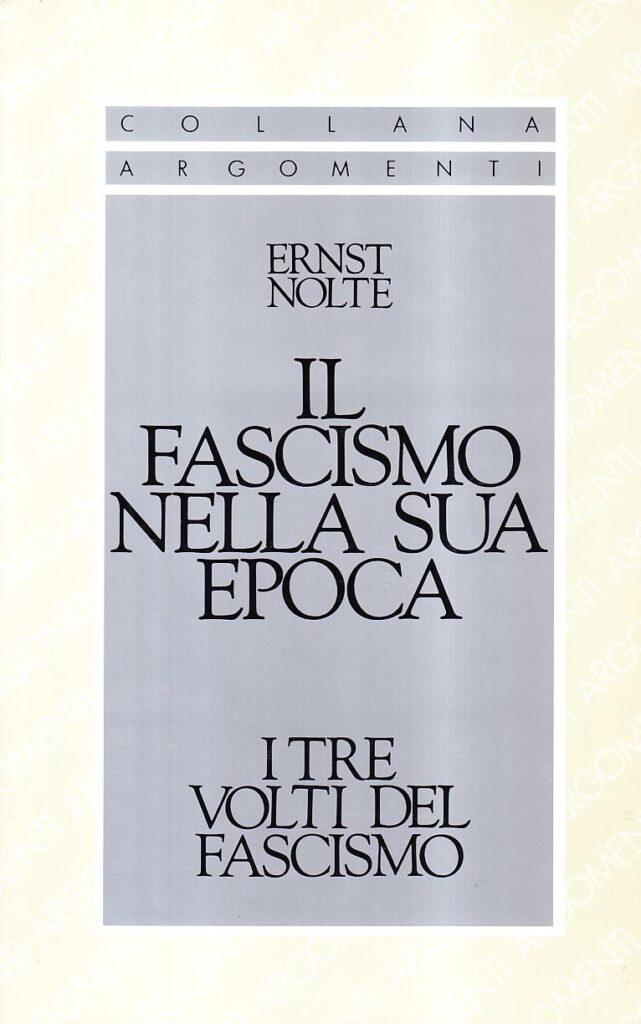
In his work Fascism in Its Epoch, Nolte proposes a “transpolitical” (and therefore philosophical) interpretation of the fascist phenomenon. Central to this interpretation is the concept of “transcendence” which he elaborates starting from Heidegger (and Marx). According to Nolte, transcendence is man’s impulse to overcome his finitude: “theoretical transcendence” seeks to overcome the given through thought by turning toward the whole, the universal; while “practical transcendence,” more specifically modern, seeks to overcome the given through technique, production, and labor, acting upon the world in a transformative sense. With its tendency toward the dissolution of limits and universalism, modernity constitutes the moment of the eruption of practical transcendence into history. According to Nolte, it is primarily Marxism and communism that radicalize practical transcendence with their attempt to transform the world and bring “progress” to its completion.
It is therefore in reaction to this radicalization of transcendence that the fascist phenomenon is born—equally radical in its intentions and methods—which Nolte defines as “resistance to practical transcendence and struggle against theoretical transcendence.” Fascisms seek to oppose the movement of transcendence with a counter-movement that forcibly brings man back within his limits: against modern “abstraction,” they want to restore concreteness, re-situating him in the immanence of “blood and soil.” This is a complex interpretation that might seem abstruse, but in my view, it captures a fundamental aspect: the will for human “emancipation” by various ideologies of progress, which “reactionary” political cultures resist. One representative of the latter, Nicolás Gómez Dávila, summarized the issue as follows: “Those who strip man of his chains release only an animal” (“Los que le quitan al hombre sus cadenas liberan sólo a un animal”).
Could you explain Nolte’s concept of the “Eternal Left”? How might we interpret this concept in the context of today’s global liberalism, the debate on human rights, and cultural progressivism?
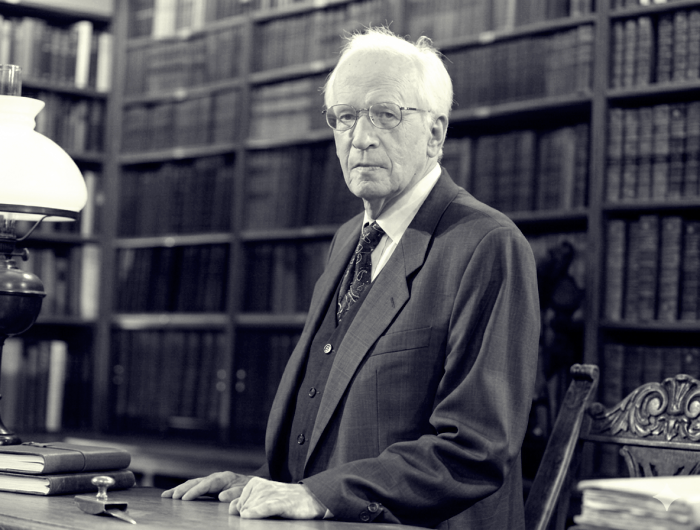
The “Eternal Left” is another concept of great interest developed by Nolte. It refers to “an emotional and rhetorical tendency that is scandalized by the established social order because it considers it ‘unjust’.” Viewing every social hierarchy involving dominant and dominated, masters and servants, rich and poor as unnatural and the result of oppression, it demands the subversion of this order and the establishment of “justice.” For Nolte, this tendency runs underground throughout entire human history and erupts periodically in bloody revolts, the archetype of which is that of Spartacus in ancient Rome.
The Eternal Left also draws nourishing lifeblood from Judeo-Christian messianism, which proclaims the coming of a Kingdom of God in which every “injustice” will be definitively suppressed. Nolte cites several examples of this manifestation of the Eternal Left: the Peasants’ War in the 16th century, the Conspiracy of the Equals, and the Paris Commune. Following his framework, we could find many others, all with a common denominator: a great violence deployed in the revolts, leading to the physical annihilation of the rulers, followed by a repression often more violent than the revolt itself. Nolte suggests that the rulers feel not only their lives threatened but also “civilization” itself; thus, civilization and justice would be, in some way, mutually exclusive terms.
For Nolte, Marxism—despite its claim to scientificity—ends up channeling the impulses of the Eternal Left, and the Russian Revolution constitutes the “first lasting triumph of the Eternal Left in a major state and, in this sense, was an absolutely unique event of its kind.” A few side notes can be drawn from Nolte’s discourse. For those who perceive the earthly order as “evil,” any action—even the most violent—to uproot evil from the world ends up justifying itself in the name of a supposed higher good that is allegedly inscribed in the “natural” path of progress. This self-justification of violence is extremely insidious and largely unresponsive to “rational” arguments.
Furthermore, we cannot think that the “Eternal Left” disappeared with the end of the Soviet Union, although it has consigned the 20th-century form of communism to the past (the historian François Furet spoke of the “passing of an illusion”). It is destined to reappear wherever social inequalities are perceived as unbearable, even without major theoretical elaborations “at the source.” As for liberal progressivism, it certainly does not possess the violent charge of the Eternal Left, nor does it truly aim to subvert social hierarchies; however, in its globalist and universalist tendencies, we cannot help but see a radicalization of that “transcendence” mentioned above, and it is entirely legitimate to expect backlashes to this. From this perspective, Nolte can be linked to other, perhaps better-known philosophical perspectives: Fukuyama’s “End of History,” if one looks at the universalistic claim of the liberal-democratic order, and Deleuze and Guattari’s “deterritorialization,” if one considers the modern dissolution of traditional roots.
Why did Nolte concern himself with the issue of Islamism in the final period of his life? How did he approach this theme?
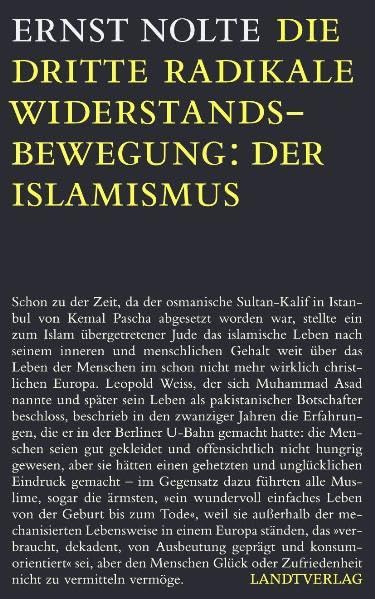
In the last years of his life, partly driven by events like September 11, 2001, Nolte came to deal with Islam. In various interventions and in a 2009 text (Die dritte radikale Widerstandsbewegung: Der Islamismus / The Third Radical Resistance Movement: Islamism), Nolte attributes to Islamism the character of radical resistance against modernity, Western universalism, secularization, and globalization. It would therefore be the “third radicalism,” the third counter-movement to modernity after communism and fascisms. It arises as a “defensive-aggressive power” which, following the collapse of the Ottoman Empire, becomes a leading political force, especially in reaction to the challenge represented for the Islamic world by the founding of the State of Israel.
A shift in Nolte’s perspective can be noted here: in his final years, he seems to evaluate communism not so much as a radicalization of transcendence, but rather as a revolt against liberal-capitalist modernity, in this sense comparable to fascisms and Islamism. Indeed, the very end of 20th-century communism may have provided new lifeblood to the “third radicalism.” However, one should not think that Nolte reduces himself to a celebrant of Western civilization, as many have naively thought. He certainly distances himself from radicalisms (viewing transcendence as a defining characteristic of man), but at the same time, he recognizes in them a form of “tragedy” and “grandeur.” Similarly, he expresses himself critically regarding the Americanization of Europe and proposes a comparison between Nazi Germany and the State of Israel that earned him fierce backlash.
Why is it necessary to reread Ernst Nolte today? Is his thought limited to explaining the 20th century, or does it still offer conceptual tools for understanding the current crises of modernity?
Nolte’s historiography has had limited resonance. Largely unrecognized in the Anglo-Saxon world, where he is considered a kind of German nationalist, and highly controversial in his native Germany, it has paradoxically found more fortune in Italy, where it has often been trivialized for “anti-communist” purposes. As I have tried to explain, Nolte’s historiography is anything but aimed at putting “totalitarianisms” on the same level to dissolve everything into a trivial celebration of the current “liberal-democratic” setup. Nolte expressed himself strongly against the idea that radicalisms represent an “absolute evil” contrasted by a supposed absolute good.
Nolte’s comparative method is instead a deep excavation into historical phenomena and ideologies, attempting to grasp a “rationality” even in what appears irrational, trying somehow to reach an understanding of man’s “historical existence” and his being-in-the-world. His philosophical historiography is an antidote both to the historiography that vainly chases the “scientificity” of the hard sciences and to the reduction of history to a clash between moral principles—between good and evil, victims and perpetrators. His perspective is therefore not exhausted by the history of the 20th century: it still offers useful categories today for understanding the crises of modernity, its unresolved conflicts, and the ever-new forms of resistance that it continues to generate.