Martin Tielke: Schmitt was a concrete political thinker; for Jünger, reality was merely a parable

Ernst Jünger and Carl Schmitt, who set out to grasp the singular features of the epoch in which we live, are two pioneering figures whose influence is still felt today. We spoke about their remarkable relationship, which went through significant ruptures and transformations over the years, with Martin Tielke, author of the monograph Der stille Bürgerkrieg: Ernst Jünger und Carl Schmitt im Dritten Reich (Landt Verlag, 2007).
The relationship between Ernst Jünger and Carl Schmitt began in Berlin in 1930 and was sustained over more than fifty years in hundreds of letters. It seems less like a classic community of shared convictions than an attraction of opposites. Yet the bond was so close that Jünger named his newborn son after Schmitt and made him the child’s godfather. What drew Schmitt so strongly to Jünger?
Perhaps Schmitt was fascinated by the fact that Jünger was, in a certain sense, his opposite: a cold persona and a soldier who nonetheless came across as highly cultivated. What is astonishing is that the friendship grew especially warm precisely in the years when the two were politically furthest apart. Jünger kept his distance from the regime from the outset, while Schmitt pinned his career hopes on the new rulers. And yet Schmitt became godfather to Jünger’s son, born in 1934, in exactly this period. Schmitt registered the contrast between their natures very precisely. He recognized Jünger’s armored self and pinched reserve, but also his capacity for self-overcoming. He saw himself, by contrast, as a powerless jurist caught in the machinery of world history. At the very beginning of the relationship, moreover, stood a compliment from Jünger, who likened Schmitt’s The Concept of the Political to a mine that explodes without a sound.
During the years of the dictatorship, the two exchanged ideas intensively about their reading. Which texts were formative for Schmitt and for Jünger in this period, and who introduced whom to authors such as Melville or Léon Bloy? Do these readings also reveal differences in the way each of them interpreted his situation?

Under National Socialism, the formative and existential texts for Schmitt were works by Herman Melville, Konrad Weiß and Annette von Droste-Hülshoff. Droste became central to him especially toward the end of the war. Melville’s story Benito Cereno preoccupied Schmitt so much that he persistently asked Jünger in his letters whether he had read it yet, and he identified with the title character himself. The ship was for him an image of a state order that had foundered in revolution and civil war. He likened the mutinous slaves to the SS that threatened him, while the leader of the mutiny served him as a cipher for Hitler. In Konrad Weiß and Droste-Hülshoff he sought above all religious and existential support. It was Schmitt who pointed Jünger to Léon Bloy, not the other way round, though he later doubted whether Jünger had understood him at all. Jünger, for his part, was more fascinated by Edgar Allan Poe. Here a fundamental difference shows itself: whereas Schmitt saw in Melville’s story an image of his own concrete political situation, Poe’s descent into the Maelstrom was for Jünger a metaphysical image. Schmitt was the concrete political thinker, whereas Jünger understood reality rather as a parable. Of Jünger’s works from this period, Schmitt valued The Adventurous Heart above all, especially the passage about the Head Ranger, but he also quoted On the Marble Cliffs again and again.
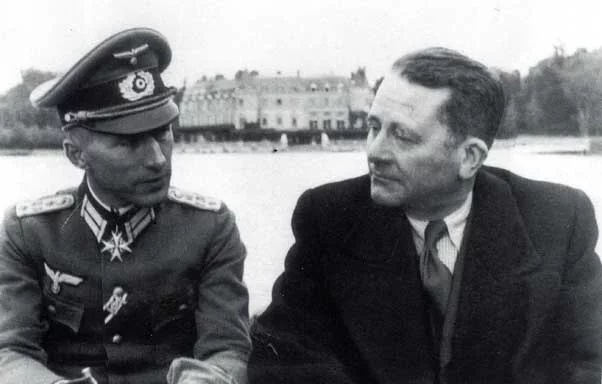
Sidelined by the regime, Schmitt had withdrawn into an inner space by 1938 at the latest, with his book on the Leviathan, and spent the war years in Berlin. Jünger, meanwhile, kept his diaries in uniform on the staff of the occupation command in Paris. Did these very different forms of “eloquent silence,” the jurist’s and the writer’s, influence each other? And how did Schmitt view Jünger’s situation in Paris?
There was hardly any mutual influence. In a certain sense Schmitt envied Jünger, since his officer’s uniform gave him a degree of protection from the Gestapo. After the war, both regarded themselves as fortunate survivors. In Schmitt’s understanding, this was because neither of them had remained a wholly private person in the National Socialist state. Jünger was a Wehrmacht officer, and Schmitt, after losing his party offices in 1936, kept the title of Prussian State Councillor. Even so, neither really grasped the danger the other was actually in. Jünger did not read Schmitt’s Leviathan book as a signal sent out of existential distress and had little sense of the peril Schmitt faced. Schmitt, for his part, believed that Jünger had led a fairly comfortable life in Paris, overlooking the fact that dangers lurked there too. Schmitt himself, by his own account, lived under constant pressure not to attract the attention of the security apparatus. In these years their relationship was marked by mutual blindness.
After the war ended, the friendship fell into a deep crisis that eventually led to a years-long break in their correspondence. Why did Jünger’s attempt in his novel Heliopolis to capture the epoch in an abstracting, mythological language provoke such deep bitterness in Schmitt? And what role did the completely changed circumstances of the two men after 1945 play in this?

After the war, the situation was completely different. Whilst Jünger, during the Nazi era, turned to surrealism with The Adventurous Heart and told a mythologically embellished story in The Marble Cliffs, Schmitt found himself under immense pressure to explain himself because of his Nazi writings. However, he refused to make a public statement because he fundamentally distrusted the public. To him, public rituals of penance were an obscene spectacle. In Ex Captivitate Salus he writes: ‘Whoever wishes to confess, let him go and present himself to the priest.’ That is precisely what he did: in June 1945, he noted that he had ‘confessed to the vicar my ruin as a legal scholar’. As the 1945 diary now makes clear, he acknowledged his ‘guilt’ very openly – but not publicly! A verse by Droste becomes something of a refrain: ‘Thus must I atone for my own guilt and folly’. Jünger need not have mythologised anything further after 1945. That he did so nonetheless, Schmitt regarded as hypocritical. On 25 November 1949, he saw Heliopolis as an escape from having to speak the harsh truth. What had taken place in Marmorklippen whilst still under the compulsion to camouflage now struck him as a pitiful evasion. Citing Heraclitus’s maxim ‘One cannot step into the same river twice’, he reproached Jünger for stepping into the same river three times with Marmorklippen, Strahlungen and Heliopolis. In a more polite letter to Jünger himself on the same day, he wrote that he was ‘a Chaopolit, not a Heliopolit’. The break only came when Jünger recounted their shared history in the subjunctive. Had Schmitt followed his advice in 1933, so Jünger argued, he might no longer be alive, but would be entitled to pass judgement on him. ‘Thus speaks a survivor to a survivor,’ Schmitt noted bitterly in the glossary. He countered with Bloy’s words, ‘Tout ce qui arrive est adorable’, and had to recognise that Bloy ‘hangs like a blind window’ on Jünger’s façade. On 5 February 1950, he replied simply: ‘Capisco et obmutesco’ (Furthermore, Schmitt was living in straitened circumstances and was in a poor financial position (no pension), whilst Jünger was soon once again a well-paid and recognised author. In July 1945, his diary reads: ‘Not a penny to my name’ On 21 August, he wrote: ‘He is safe; I am sitting here on the Orel’. A certain degree of envy may well have played a part here. However, that alone does not explain the break. The often-cited ‘resentment’ on Schmitt’s part falls short, because behind it lay objective differences that only came to the fore after the end of the Nazi state.