Abderrahim Oujaha: In the Maghrib, the art of the shamāʾil and the prophetic hilya is tied to a long history of love and veneration for the noble person of the Prophet ﷺ, a tie clearly reflected in the region’s heritage
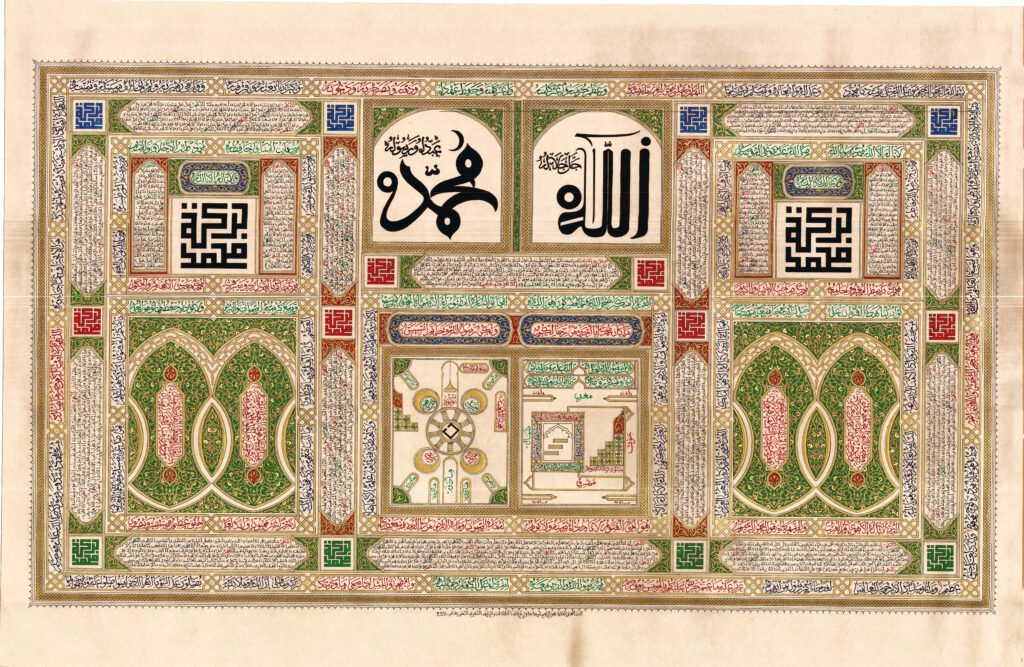
Abderrahim Oujaha is a Moroccan calligrapher who teaches calligraphy at the Ṣahrīj Madrasa in Fez. At the heart of his work are Maghribi panels of the shamāʾil, the noble description of the Prophet. We spoke with him about this tradition.
Could you tell us briefly about your artistic journey and how your passion for calligraphy began? How did you first come into contact with this venerable art?

I am the calligrapher Abderrahim Oujaha. My relationship with Arabic calligraphy began in childhood: the beauty and harmony of letters drew me in, and fine writing would stop me in my tracks wherever I came across it. At first this interest was bound up with memorizing the Qurʾān in the Qurʾānic schools (kuttāb): writing verses on wooden boards coated with clay, with reed pens and the traditional ink (ṣamgh) from the inkwells, was the first experience that shaped my visual taste. Contemplating the handwriting of the shaykhs who taught us to memorize, the riches of our heritage manuscripts and the titles of religious books also did much to deepen this passion.
Over the years this inclination turned into a conscious and disciplined practice, especially after I received the first principles and rules of calligraphy from my esteemed teacher Abdellah Hmine. In 2017 I joined the Arabic calligraphy programme at the Ṣahrīj Madrasa, part of al-Qarawiyyīn University in Fez, as one of the programme’s first cohort. It was an important stage that allowed me to go deeper into the foundations of the art and to develop my skills on sound scholarly and artistic grounds.
I was later appointed to teach in the same programme, as a way of passing on what I had learned and helping to train new generations of calligraphers. Among the blessed milestones of my career of which I am proud is receiving the Mohammed VI Prize for Excellence in Maghribi Calligraphy.
What is the historical background of the traditions of the shamāʾil and the prophetic ḥilya in the Maghrib? Does working on these panels require a scholarly licence (ijāza) or a particular chain of transmission (sanad) from the masters of the craft, or is the field open to every calligrapher?
In the Maghrib, the art of the shamāʾil and the prophetic ḥilya is tied to a long history of love and veneration for the noble person of the Prophet ﷺ, a tie clearly reflected in the region’s heritage, both in written works and in calligraphy and ornament.
Among the most important sources that gave this field its foundations is al-Shifāʾ bi-taʿrīf ḥuqūq al-Muṣṭafā by Qāḍī ʿIyāḍ, in which he gathered the physical and moral qualities of the Prophet ﷺ. The tradition then broadened its horizons with Dalāʾil al-khayrāt by Shaykh Muḥammad b. Sulaymān al-Jazūlī, a work that does not stop at prayers of blessing and litanies but also contains symbolic elements connected with the depiction of sacred places and relics, such as the Noble Rawḍa, the Sacred Mosque and the Prophet’s Noble Sandal. To these must be added Fatḥ al-mutaʿāl fī madḥ al-niʿāl by the eminent scholar Aḥmad al-Maqqarī.
As for the artistic side and the development of the “Rawḍ Sharīf” panels, the calligrapher Aḥmad al-Tādilī al-Ribāṭī came to prominence in the first half of the twentieth century. Drawing on elements from the heritage found in Dalāʾil al-khayrāt, he arranged them into integrated artistic compositions that became a landmark in this art.
Coming to the present day, my teacher Dr. Mohamed Abdelhafid Khabta El Hassani El Idrissi played a major role in reviving the art of the Rawḍ Sharīf and in grounding it historically and artistically. He studied and documented its elements, devised a complete geometric scheme for the ḥilya and Rawḍ Sharīf panel, and carried it out together with the master calligrapher Omar Adala.
As for the ijāza and the sanad, in my view the matter does not necessarily come down to holding a formal licence in calligraphy; what it requires above all is precise knowledge of the content and a grasp of its historical and symbolic dimensions and of the rules on which it rests. I had the opportunity to study this aspect during my training in the calligraphy programme under my teacher Dr. Mohamed Abdelhafid Khabta, author of al-Ḥilya al-nabawiyya al-maghribiyya, and I benefited greatly from studying the traditional examples in his book, especially the works of Aḥmad al-Tādilī al-Ribāṭī.
On this basis, my own work drew on the traditional architecture of the Rawḍ Sharīf and on the particular features of the prophetic ḥilya. It set out to bring together elements scattered across other panels and to set the texts of the noble description in place, while adding artistic choices and perspectives that give the panel its own signature, such as drawing symbolic miniatures of the Prophet’s Mosque and the Noble Kaʿba. The aim is always to combine reverence for the foundations and fidelity to the spirit of this art with a wide horizon for disciplined ijtihād and renewal.
We see that the Ottoman ḥilya generally follows a vertical design, while the Maghribi ḥilya tends towards a horizontal form. What are the artistic, aesthetic and symbolic reasons behind this difference?
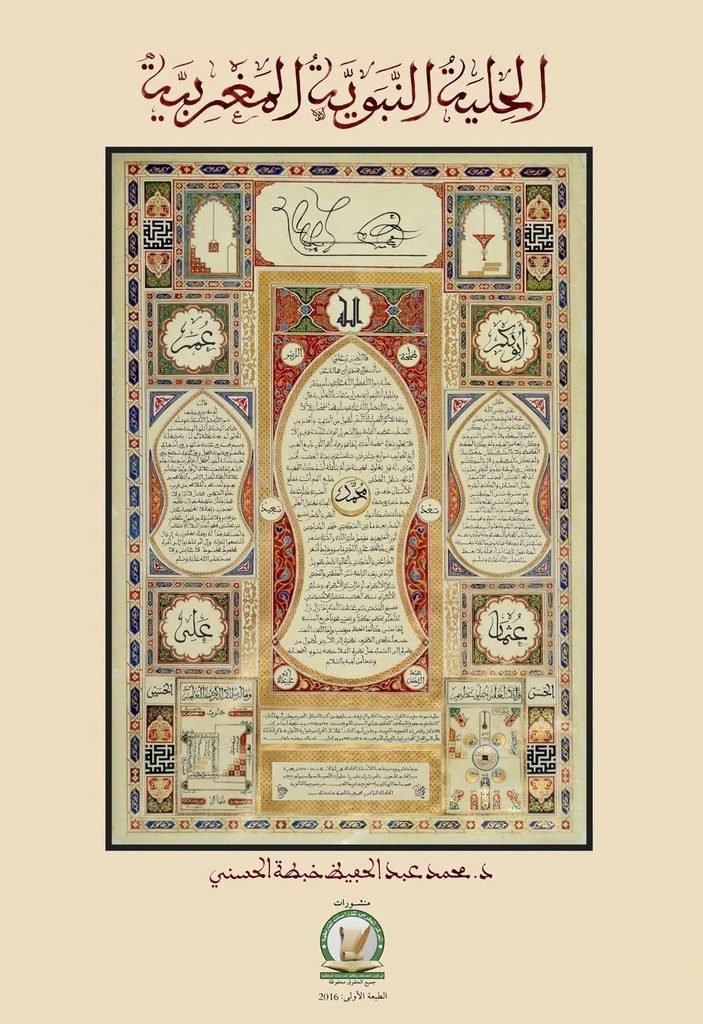
In my view the difference comes from the nature of the elements that make up each panel and from the way texts and symbols are distributed within the overall space.
The Ottoman ḥilya settled on the vertical arrangement established by the calligrapher Hafiz Osman. Its elements are ordered in a descending sequence: the basmala at the top, then the star-shaped central medallion and the crescent, followed by bands and Qurʾānic blocks, down to the bottom of the panel. It is a structure built on a single visual centre and a clear vertical flow.
The Maghribi ḥilya, by contrast, was shaped by the tradition of the Rawḍ panels, which draws on shamāʾil literature and on al-Jazūlī’s Dalāʾil al-khayrāt, as we see clearly in the work of Aḥmad al-Tādilī al-Ribāṭī. Its structure is therefore different and leans distinctly towards horizontal extension, for several reasons:
First: the presence of symbolic motifs that need a broad horizontal space, foremost among them the image of the Noble Sandal, represented by a pair of the blessed sandals.
Second: an internal arrangement based on correspondence and symmetry. The divine name “Allāh” is placed together with a depiction of the Sacred Mosque on one side, and facing it, on the parallel side, the name “Muḥammad” ﷺ with a depiction of the Prophet’s Rawḍa and the miḥrāb.
Third: the panel contains bands for litanies and prayers, and friezes framed at the corners by square Kufic (as in the phrase “Barakat Muḥammad”). This makes horizontal extension a choice dictated by the very nature of the composition and the number of its symbols, so that balance is achieved without crowding and without disturbing the overall structure.
In building the visual composition of a panel, how do you reconcile the variety of scripts, such as Kandūsī and Maghribi Kufic, with the placement of symbols like the Noble Sandal and of the text blocks? Do you rely on a fixed traditional template, or do you rebuild the geometric and aesthetic space in each work?
There is no rigid geometric template that imposes itself on every work. Each panel has its own character, arising from the volume of its texts and its aesthetic purpose, although the starting point is always respect for the established rules in order to achieve proportion and harmony between the different areas.
In distributing the scripts, care is taken to assign each one to the place that best brings out its beauty and its function:
- The names “Allāh” and “Muḥammad” ﷺ are given the dignity of the Kandūsī script, with a density and weight that grant them visual primacy in the panel.
- Maghribi thuluth is used for the names of the Rightly Guided Caliphs (may God be pleased with them) and to adorn the main bands.
- The mabsūṭ script is used to record the prophetic texts and the noble descriptions, because of its clarity and the great ease with which it is read and taken in.
- The mujawhar script is reserved for annotations and fine marginal notes.
Square Kufic (as in the phrase “Barakat Muḥammad”) settles in the corners and joints, framing the space and shaping the geometry of the transition between the text blocks and the ornamental friezes.
As for the symbols, we do not treat the image of the Noble Sandal as a decorative element cut off from the content; rather, we work it into the heart of the overall composition, with phrases from the shamāʾil running through its space in a harmonious script. Text and symbol thus become a single, unified fabric, and the panel emerges balanced, speaking of tradition while at the same time expressing a particular artistic vision and ijtihād.

Which traditional sources and manuscripts do you rely on when choosing the verses, hadiths, prayers and shamāʾil texts included in these panels?
Care in selecting texts is a fundamental pillar, inseparable from the aesthetic value of the work. That is why we rely on the trustworthy principal sources: the Qurʾān, the prophetic Sunna, and works of shamāʾil, praise poetry and prayers of blessing.
These references fall under clear headings:
First: Verses of the Noble Qurʾān
We select verses that bear witness to the exalted rank of the Chosen One ﷺ and to his lofty character, such as the words of God Most High:
لَقَدْ جَاءَكُمْ رَسُولٌ مِنْ أَنْفُسِكُمْ عَزِيزٌ عَلَيْهِ مَا عَنِتُّمْ حَرِيصٌ عَلَيْكُمْ بِالْمُؤْمِنِينَ رَءُوفٌ رَحِيمٌ
“There has certainly come to you a Messenger from among yourselves; your hardship weighs heavily upon him; he is ardently concerned for you, and to the believers he is gentle and merciful.” [al-Tawba 9:128]
يَا أَيُّهَا النَّبِيُّ إِنَّا أَرْسَلْنَاكَ شَاهِداً وَمُبَشِّراً وَنَذِيراً وَدَاعِياً إِلَى اللَّهِ بِإِذْنِهِ وَسِرَاجاً مُنِيراً
“O Prophet, We have sent you as a witness, a bearer of glad tidings and a warner, as one who calls to God by His leave, and as a light-giving lamp.” [al-Aḥzāb 33:45–46]
وَمَا أَرْسَلْنَاكَ إِلَّا رَحْمَةً لِلْعَالَمِينَ
“We have sent you only as a mercy to the worlds.” [al-Anbiyāʾ 21:107]
وَإِنَّكَ لَعَلَىٰ خُلُقٍ عَظِيمٍ
“And truly you are of a sublime character.” [al-Qalam 68:4]
In addition, the Throne Verse (Āyat al-Kursī) and other verses on the same theme are used in the bands surrounding the work.
Second: Books of Hadith and of the Prophetic Shamāʾil
We rely on the established hadiths describing the Prophet ﷺ, foremost among them the narration of our master ʿAlī b. Abī Ṭālib (may God be pleased with him) in al-Tirmidhī, the hadith of Hind b. Abī Hāla cited by Qāḍī ʿIyāḍ in al-Shifāʾ, and the narration of Umm Maʿbad al-Khuzāʿiyya in al-Ḥākim’s al-Mustadrak.
Third: Collections of Praise Poetry for the Prophet
The finest poems, which have settled deep in the Maghribi and wider Islamic sensibility, also find their place, foremost among them Imam al-Būṣīrī’s al-Burda and al-Hamziyya, and the ode “Bānat Suʿād” by Kaʿb b. Zuhayr (may God be pleased with him); from these we choose the verses best suited to the rhythm and space of the panel.
Fourth: Books of Prayers of Blessing and Works of the Maghribi Heritage
Their mainstay is Dalāʾil al-khayrāt by Shaykh Muḥammad b. Sulaymān al-Jazūlī, for the litanies, formulas of blessing and sacred scenes it contains, and Fatḥ al-mutaʿāl fī madḥ al-niʿāl by the eminent scholar Aḥmad al-Maqqarī, together with a survey of older examples of the Rawḍ Sharīf, especially the works of the calligrapher Aḥmad al-Tādilī al-Ribāṭī.
Returning to these authentic springs is therefore not merely a compilation of texts; it is the solid foundation on which the structure of the panel is determined. Only then comes the stage of choosing the scripts and distributing the elements in a visual order that preserves the majesty and awe of the meaning.